
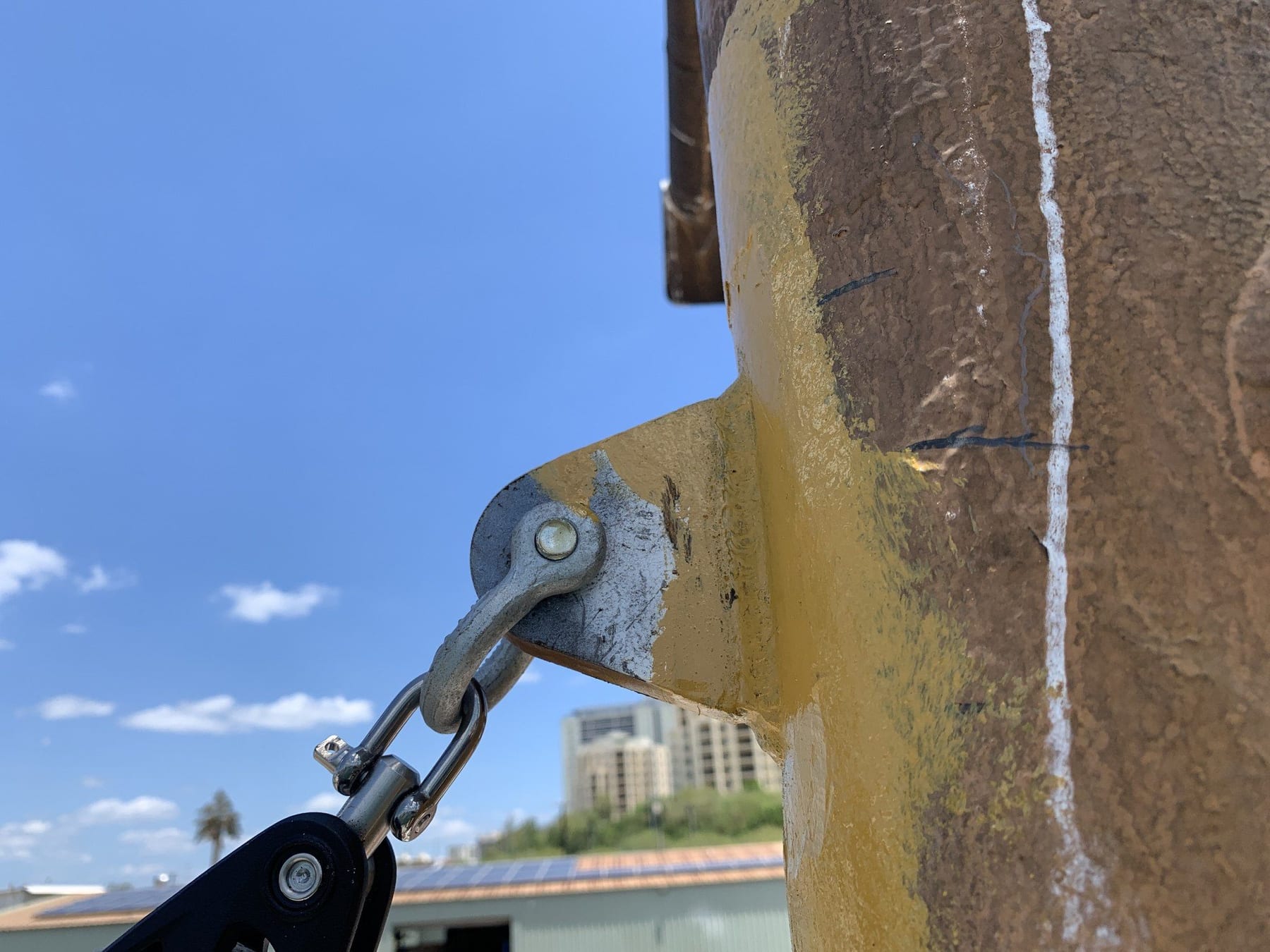
Pad eye, lifting lug & load testing
Proof loaded. Crack checked.
Proof load testing of pad eyes, lifting lugs and lifting points at the wharf, in the yard or in the fabrication shop. Our PT12 tester pulls up to 12 t straight off the pad eye. Rigged tests with calibrated load cells go to 20 t.
- Green Monster PT12
- 12 t direct pull
- Load cells 5–20 t
- Marine Order 32
- MT & PT before and after
- Proof load certificates
Do you need it?
A proof load test shows the lifting point holds. The NDT shows it didn’t crack.
A proof load test pulls a pad eye, lug or lifting point past its safe working load (SWL), holds it, and checks it afterwards for cracks and permanent set. It’s done before first use or after a repair, so the item goes on your lifting register with evidence behind it.
We check the eye and its welds before the pull, apply and hold the proof load, then measure and check again. If the drawing gives a proof load we test to that. If the gear falls under Marine Order 32, we test to its Schedule 3.
- 01
No crane needed
The PT12 pulls straight off the pad eye. No test weights.
- 02
Past 12 t, rigged
Calibrated 5–20 t load cells for rigged tests up to 20 t.
- 03
NDT either side
MT or PT before and after every pull.
- 04
Measured for set
Reference distance across the eye, before and after.
Pad eye tester
Green Monster PT12. No crane, no test weights, just the pad eye.
The PT12 sits over the pad eye, pins through it and pulls hydraulically, bearing on the deck around it. A hand pump builds the load and a calibrated gauge reads it. It’s small enough to carry onto a vessel or into tight spots.
Working load limit
12,000 kg
Rated on the PT12’s plate. Direct pull up to 12 t.
Force gauge
0–125 kN
Calibrated by a NATA-accredited calibration lab.
Pad eye sizes
Two clevises
Interchangeable, to suit different pad eyes.
Portable
Carry it on
Works inverted. Packs in its own transport case.
Marine Order 32
Proof loads to Marine Order 32.
Marine Order 32 (Cargo handling equipment) covers gear used to load and unload vessels. Schedule 3 sets the proof load for each type of gear, and after the test the item is examined for damage or permanent deformation. We test to Schedule 3, or to the proof load on your drawing or ITP.
Rigged tests
Past 12 t, we rig it and measure it.
When the load is past the PT12’s 12 t, or the lifting point won’t take the tester, we rig the test with a calibrated load cell in line. The pull comes from a chain block, hoist or crane, and the load cell reads the load live while we hold it at proof.
- Calibrated load cells from 5 t to 20 t
- A portable indicator shows the load as it builds, so the proof load is reached and held without overshooting
- Rigging planned to suit the item and the site
- Load cell and PT12 gauge calibration details go on your certificate
What we test
Pad eyes & lifting lugs
On vessels, barges, masts, skids and structures, before first use or after repair.
Frames & spreaders
Lifting frames, spreaders and beams, attached the way they’re designed to lift.
Baskets, bins & pallets
The proof load carried on the floor of the item, as Marine Order 32 asks.
Witness testing
We witness and report load tests run by others, to your specification.
Before and after
NDT before and after every pull.
- 01
Check before
Visual, plus MT on steel or PT on aluminium and stainless, on the eye and its welds.
- 02
Measure
Reference distance across the eye, recorded before the pull.
- 03
Pull & hold
Proof load applied, held and recorded.
- 04
Measure again
Any change in the distance shows permanent set.
- 05
Check after
Visual and MT or PT again, for cracks at the weld toes and the eye.
NATA accredited (No. 12303) for magnetic particle and penetrant testing, so the crack checks either side of the test carry weight. The load test itself isn’t on our NATA scope.
What you get
A certificate for every item, with the evidence behind it.
Each item gets its own line on the certificate, backed by the NDT and measurements either side of the test, ready for your lifting equipment register.
- A proof load certificate listing each item, its SWL, the proof load applied and the result
- NDT reports for the checks before and after the test
- Before and after measurements across the eye
- Photos of each item
- The tester or load cell used, with its calibration details
What we need from you
Three things.
- The SWL and proof load for each item, or the drawing
- Certified slings and shackles, rated for the test load
- Safe access, and a clear zone around the test
At the wharf
Vessel masts, deck pad eyes, davits and barges, tested where they sit.
In the yard
Lifting frames, spreaders, skids and baskets, tested before they ship.
Remote sites
The PT12 and load cells travel with our technicians, wherever the job is.
More on the crack checks: MT, PT and visual inspection.
- NATA 12303
- ISO 9001
- AINDT
Brochure
Pad eye and load testing
PT12 pad eye tester to 12 t and calibrated load cells, to Marine Order 32.
4 pages · PDF 0.7 MB
Get in touch
Pad eyes due for a proof load test?
Swift reporting, round the clock.