
Post-weld heat treatment & preheat
Heat treated, charted and signed.
PWHT and preheat on site with six multi-channel power units and ceramic pad heaters, or in our Darwin workshop kiln. Every cycle is programmed and recorded, with digital logging if you want it.
- Site PWHT & preheat
- 36 control channels
- Pads rated to 1050 °C
- Kiln to 1200 °C
- ASME B31.3
- ASME B31.1
- AS 4458
- Digital logging
Do you need it?
Your code or WPS says when. We do it to the procedure.
Post-weld heat treatment (PWHT) heats a finished weld to a set temperature, holds it, and cools it at a controlled rate. It relaxes the stress welding locks into the joint and tempers the heat-affected zone. Codes call for it on thicker and alloy welds, and your WPS or specification sets the cycle.
Preheat is applied before and during welding. It slows cooling and drives off moisture, which lowers the risk of hydrogen cracking. We do both on site with pad heaters, or in our workshop kiln for items that fit.
01
Relieve residual stress
PWHT relaxes the stress left by welding, cutting the risk of cracking in service.
02
Temper the HAZ
Brings hardness down and toughness up in the heat-affected zone.
03
Preheat
Slows cooling and drives off moisture before welding, lowering the risk of hydrogen cracking.
Site heat treatment
Six power units. Thirty-six channels.
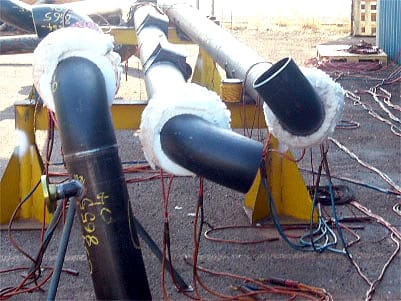
Local PWHT and preheat on site of pipe butt welds, branches and pipe-to-flange joints, with ceramic heating pads rated to 1050 °C. Each unit runs six low-voltage channels, each on its own programme, so several welds can heat at once.
Power
4 × 65 kVA
Six-channel power units, a programmer on every channel.
Mannings
2 × 50 kVA
Six channels each, run alone or alongside the 65 kVA units.
Heating
Ceramic pads
A large stock of flexible low-voltage pad heaters and cables, rated to 1050 °C.
Control
Recorders
Programmers and chart recorders, with digital logging as an option.
Local PWHT set-up
Set up to the procedure, weld by weld.
- A heated band at least five wall thicknesses wide
- Gaps between pads kept to the wall thickness or less
- Insulation at least 300 mm past the heated band either side, and open pipe ends blanked
- Thickness changes and flanges: two independently controlled bands, plus a band on the flange where it needs one
- Vertical pipe: bands biased below the weld
- Branches: a separate circuit on each one
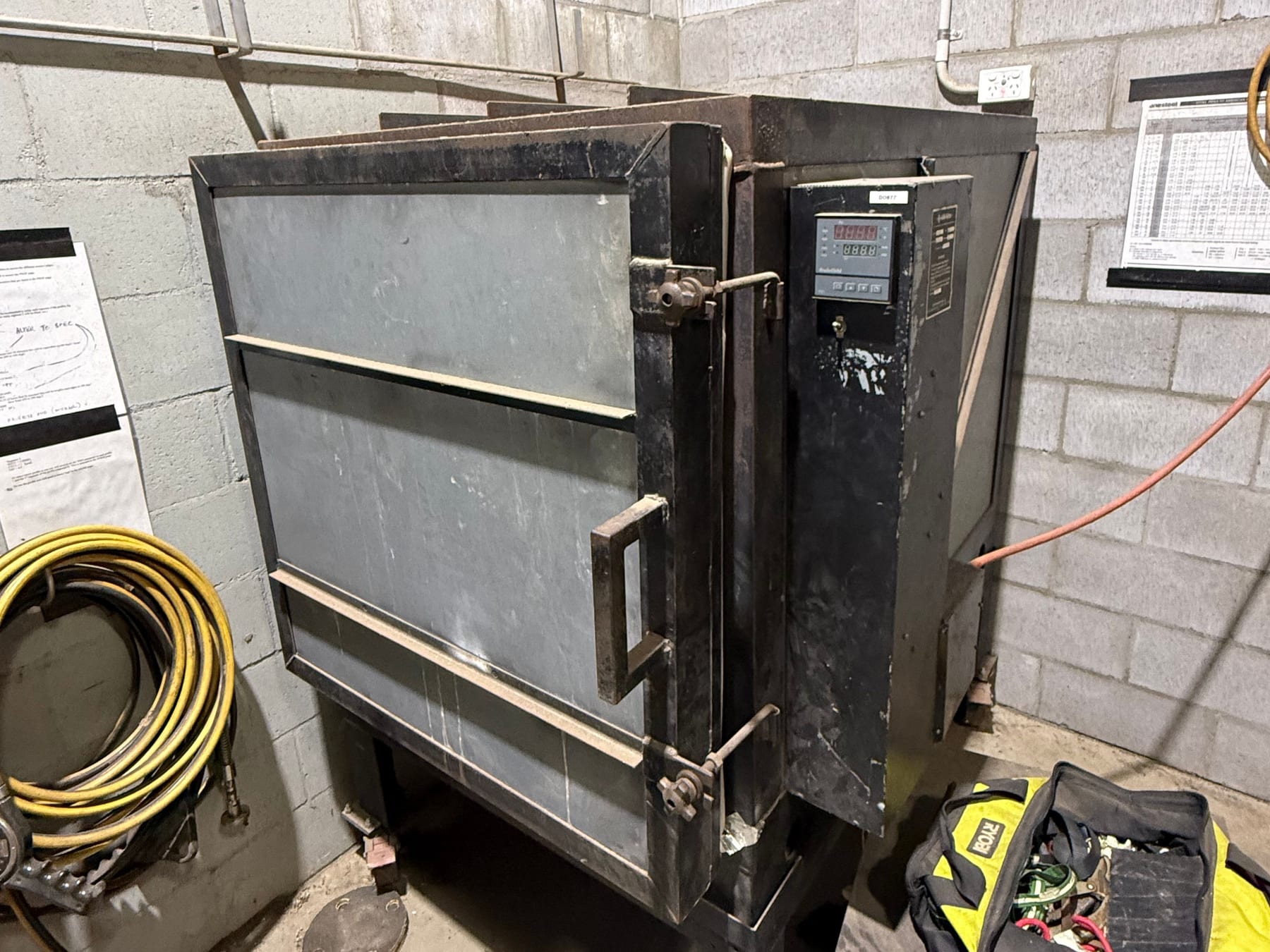
Workshop kiln
800 × 800 mm, 1.2 m deep. Made for small spools.
For spools, fittings, flanges and test coupons, our programmable kiln heat treats the whole item in one go, with no pads to place. Bring it to our Darwin workshop and it’s run to your cycle and recorded.
- Pipe spools up to 1.2 m long
- Flanges, fittings and small fabrications
- Welder and procedure test coupons
- Batches of small parts in one cycle
Bigger item? We can build a larger kiln to suit the job.
- Chamber
- 800 × 800 mm
- Depth
- 1200 mm
- Up to
- 1200 °C
- Control
- Programmable
- Where
- Our Darwin workshop
Control and records
Programmed, recorded and logged.
On every circuit
Programmers
Heat-up rate, soak and cool-down set on the programmer. Circuits on the same weld run as slaves to one programme, so the joint heats evenly.
On the weld
Thermocouples
Type K, welded on by capacitor discharge from certified wire, at least one per heating circuit.
Calibrated
Recorders
Multi-point Type K recorders, calibrated at least every 12 months against a traceable calibrator.
On request
Digital logging
Every thermocouple logged digitally as well as the paper chart, for a clean record in your data book.
Codes we work to
Done to the code, for the right reasons.
- 01
Plan
Cycle from the code, WPS and your spec.
- 02
Set up
Pads, thermocouples and insulation to the procedure.
- 03
Heat & soak
Controlled heat-up, then held at temperature.
- 04
Cool
Controlled cool-down to the code’s limit.
- 05
Report
Chart, log and report for each weld.
What you get
A chart and a report for every weld.
The report records what was done to each weld and the chart proves it, so your QA and data book have the evidence.
- PWHT report
- Weld IDs, cycle, technicians and any deviations
- Temperature chart
- Soak marked, with the recorder number
- Thermocouple sketch
- Positions on every weld
- Digital log
- Every thermocouple, on request
Welder qualifications
Preheat and PWHT of test coupons for procedures that call for it, in the kiln or on pads, next to our three welder qualification bays.
NDT after heat treatment
MT, UT and radiography from the same team once the weld has cooled, so the job closes out in one visit.
Get in touch
Welds due for heat treatment?
Swift reporting, round the clock.